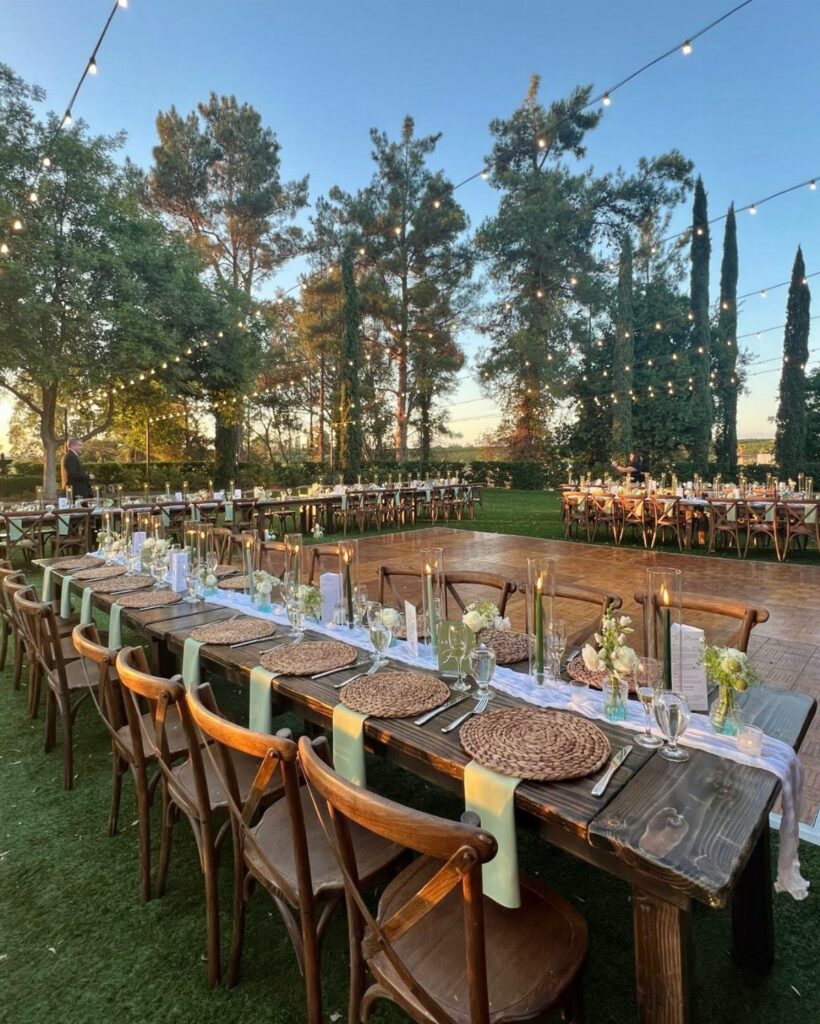
A long table wedding can run from standard banquet rentals with full linens to farm tables shipped in from specialty suppliers, with serpentine curves and overhead installations pushing both budget and planning hours higher.
The deciding factor is what your local rental company actually carries in stock, since shipping unusual shapes from another city eats budget fast.
[link-whisper-related-posts]1. Single Long Table
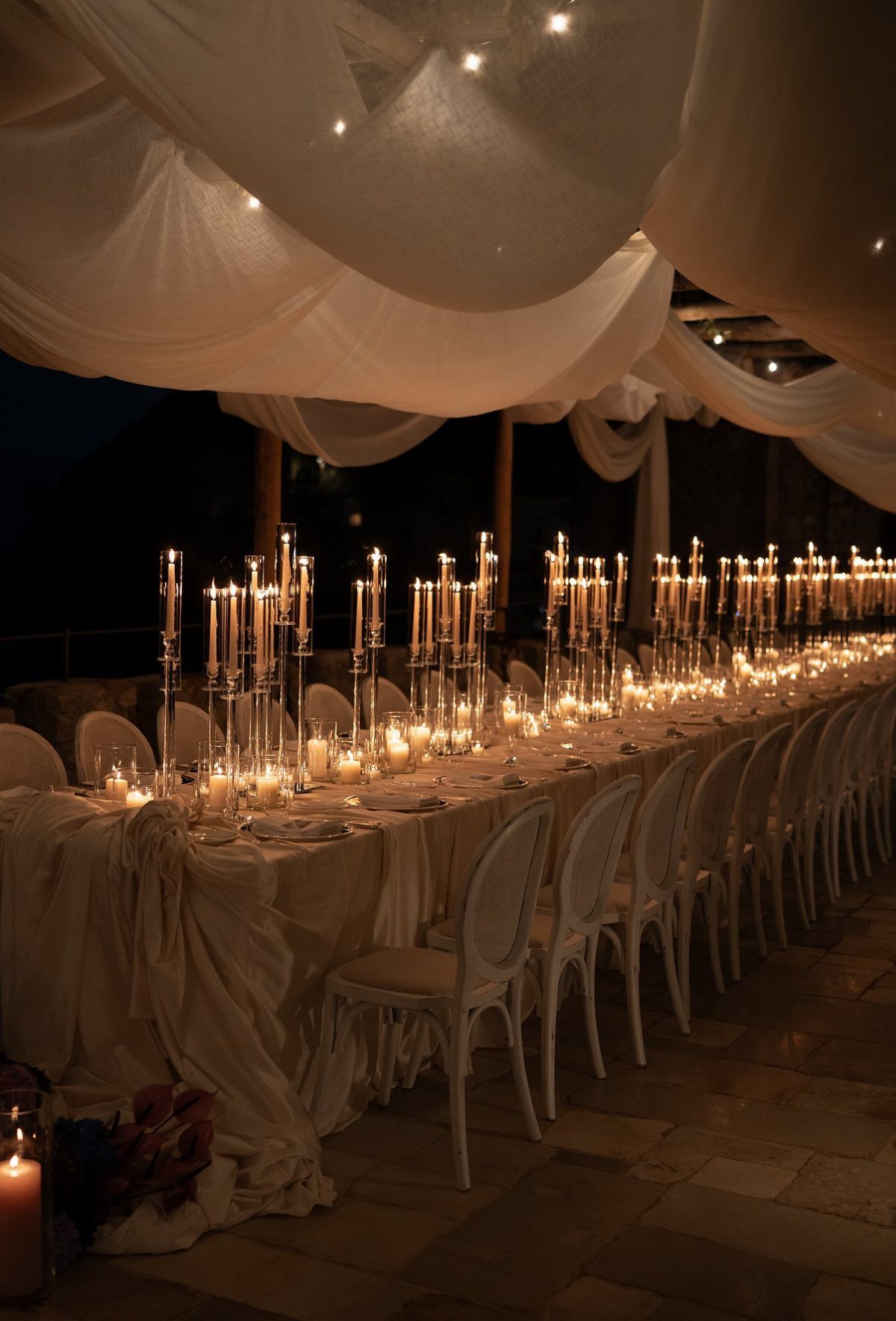
One table running the full length of the room makes the seating itself part of the look. Every centerpiece becomes a procession, every place setting part of a larger rhythm.
This layout suits smaller guest lists, up to about 100, where one continuous line keeps everyone in sight and conversation within shouting distance.
It demands a venue with the length to spare; a squashed single table loses the drama and gains awkward corners.
Budget-wise, one long cloth covers more ground than several rounds, but you will spend more on flowers or candles to fill that stretch.
Visual impact comes at a cost: without a separate head table, you lose the easy option of seating someone with a crutch or a restless toddler near an exit.
2. Farm or Vineyard Table
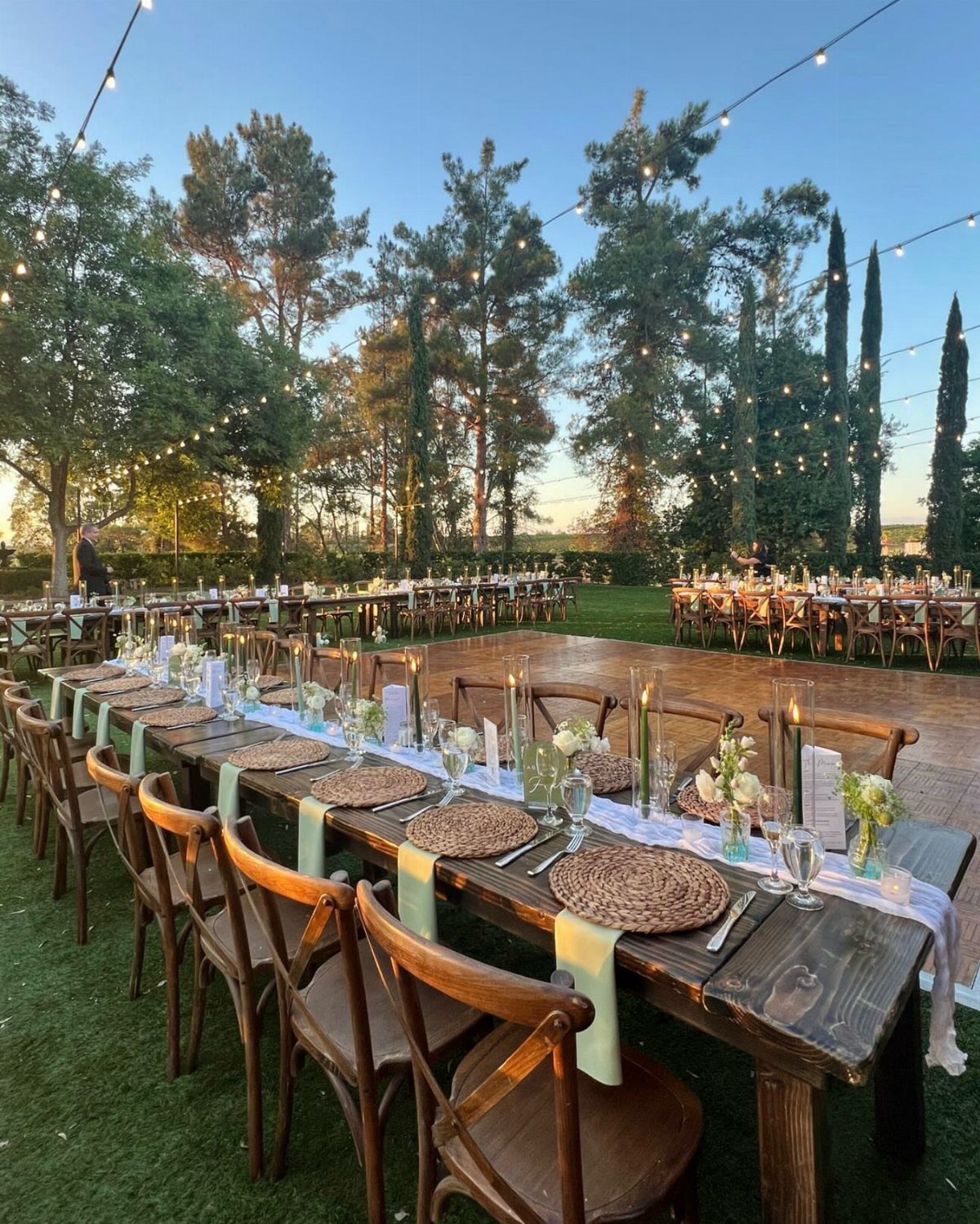
These tables arrive as they are, wood grain and all, which saves you the linen rental and changes the whole look.
Most run 6 to 8 feet long and 36 to 42 inches across, wide enough for shared platters but not so wide you lose the person across from you.
The finish matters more than the name.
Some suppliers offer dark walnut, others a pale, almost bleached oak, and the hardware shows on some, hides on others. Ask to see the actual tables, not the sample photo; the same description covers a lot of variation.
Benches cost less and seat more, though guests in tight skirts or late pregnancy will appreciate chairs. If you mix the two, put chairs at the ends where the wedding party sits, benches in the middle for cousins and plus-ones.
3. Serpentine Tables
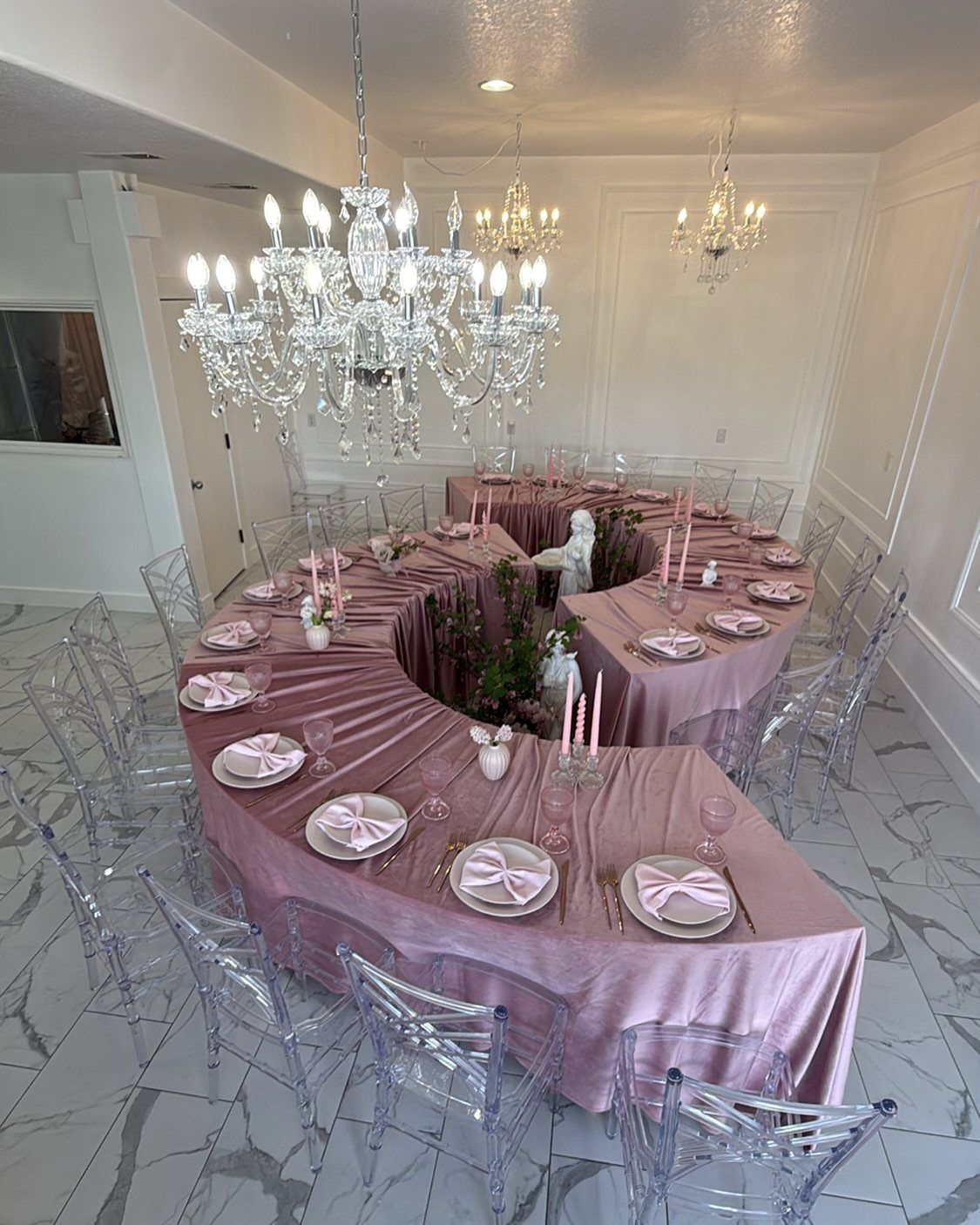
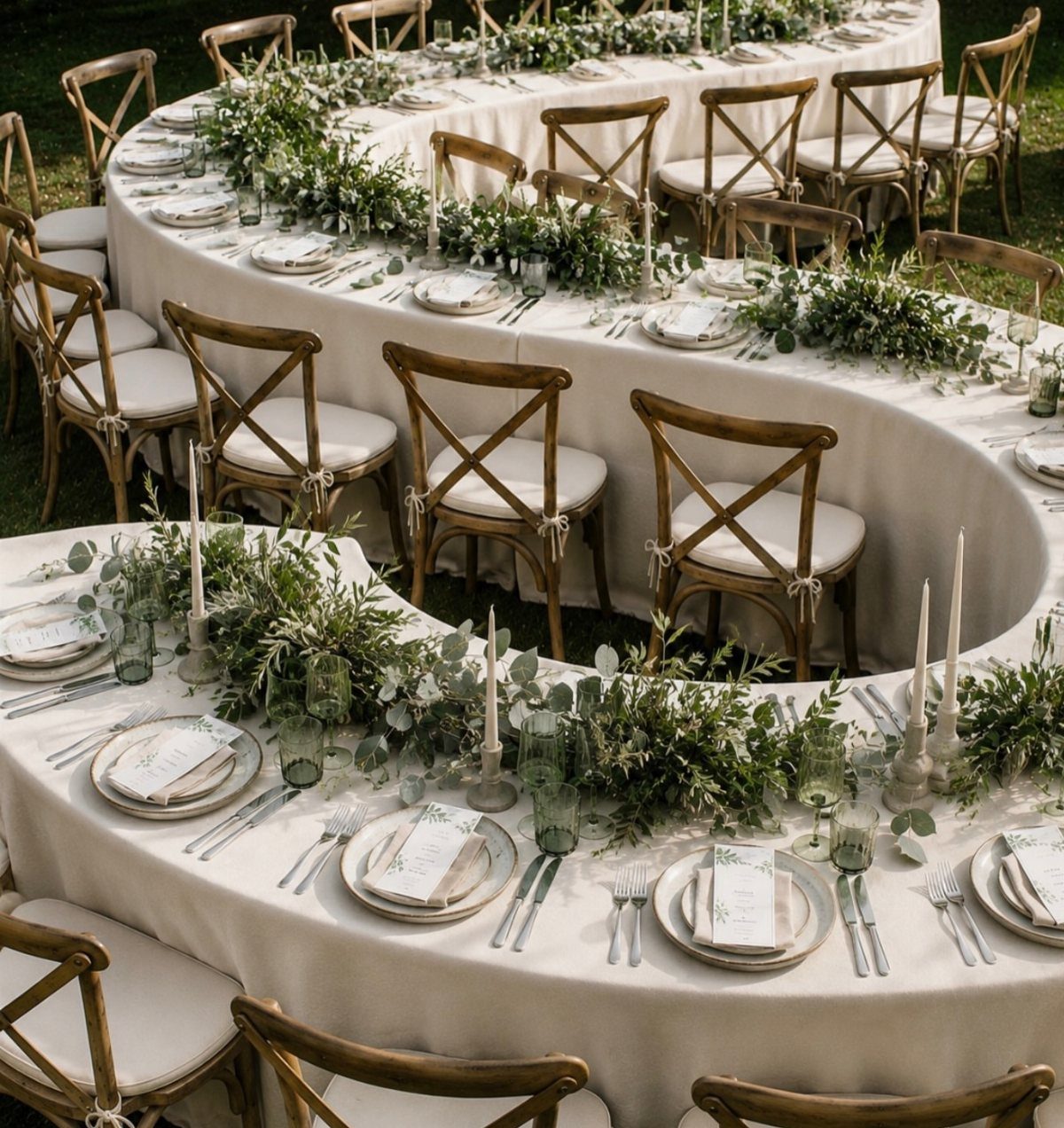
Curved segments lock together into a winding snake of a table that no guest walks past without noticing. The shape forces a banquet-style meal, no rounds, no hiding from the centerpiece.
This is not a layout you sketch yourself and hope the rental company agrees. The curves have fixed radii, the legs land where the legs land, and the linen has to be cut for the shape or seamed to fit.
You need a planner who has done it before and a caterer who knows how to serve a station where no one sits across from their server.
A serpentine layout reads as intentional design rather than furniture pushed into rows. The cost is every decision made twice: once for the straight, once for the curve.
4. Long Table Décor
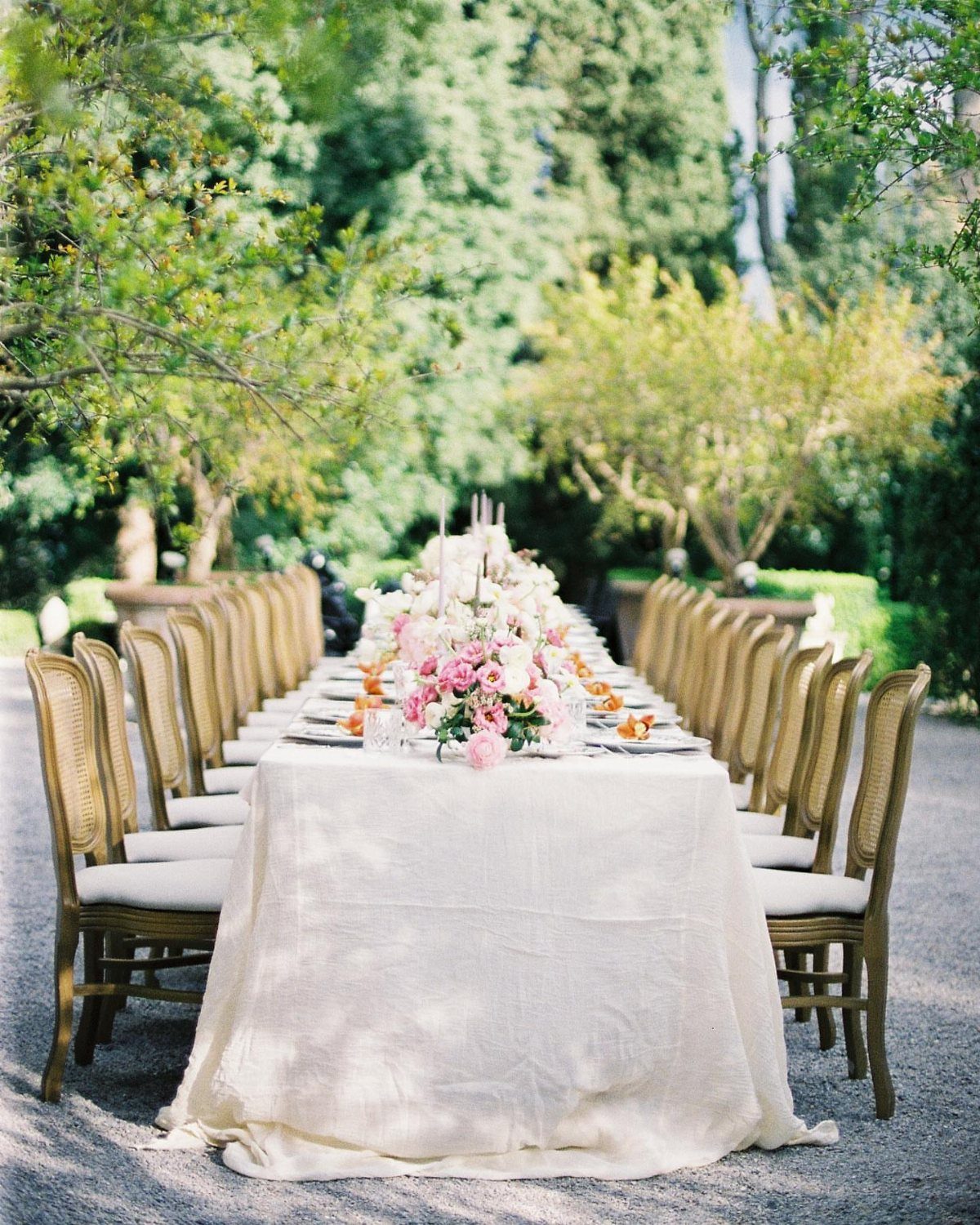
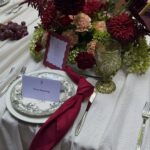
Symmetry is the tool that makes a long table look intentional rather than accidental. Repeat the same cluster of flowers and taper candles at measured intervals, and the eye reads it as one continuous gesture.
What changes is the spacing: too far apart and the table looks empty, too close and guests cannot see each other past the stems.
Space clusters close enough that every guest has something to look at across the meal without leaning around a neighbor.
Candles need protection from any breeze if you are outdoors, and real flame may be restricted by your venue. LED tapers have improved enough to fool a camera; test them in daylight before you commit.
5. Head Table
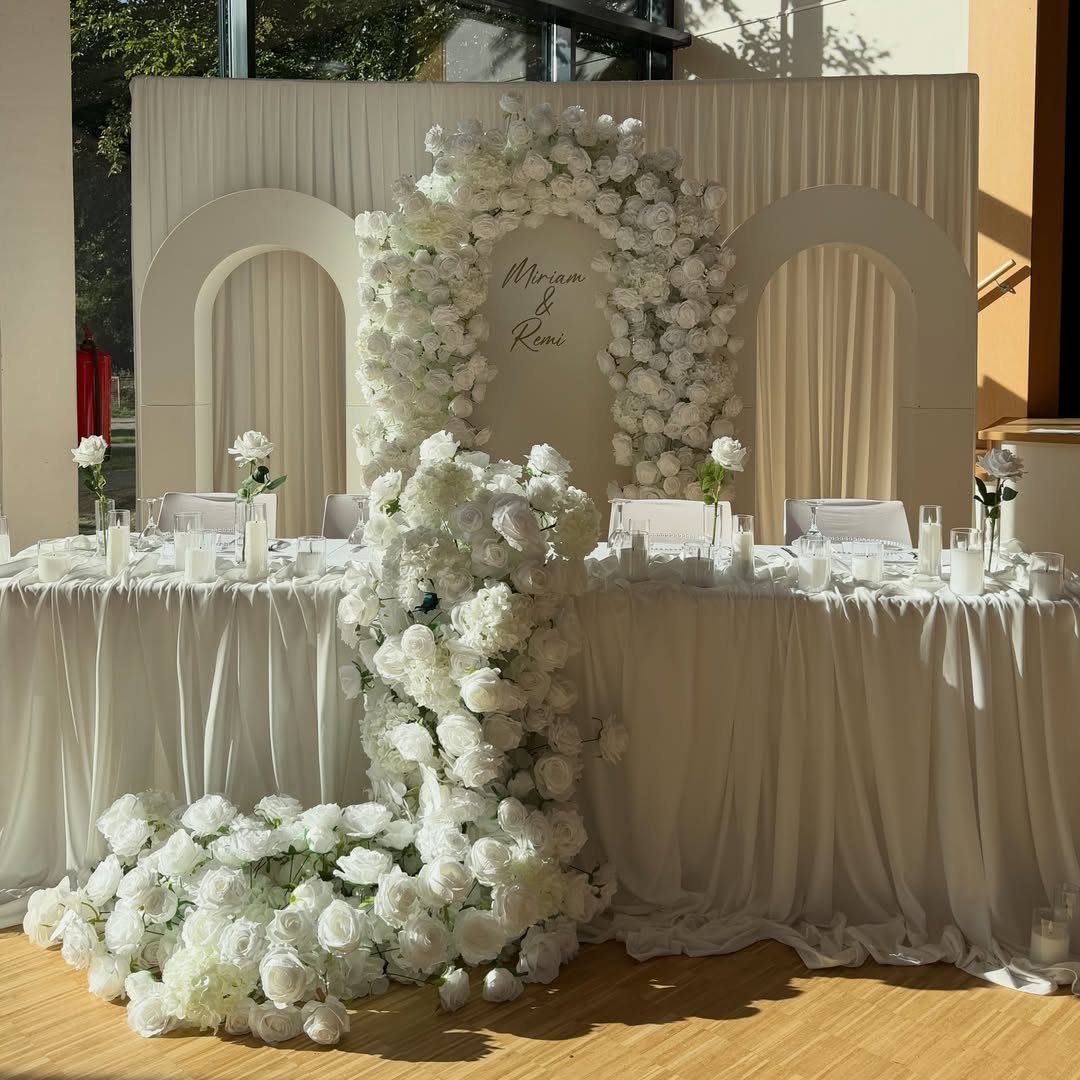
The head table borrows the long shape for a smaller group, usually the couple plus the wedding party, sometimes just the couple alone.
It can stretch to a full king’s table with attendants and their partners, or shrink to a sweetheart width if you prefer privacy.
The stretched-out shape invites a backdrop: flowers, fabric, or a painted name arch hung behind the couple. The table itself becomes a stage, which suits couples who plan to stay seated through introductions and toasts.
The drawback is separation.
Your college roommate ends up at a round across the room while you face everyone like a panel of judges. Some couples solve this by skipping the head table entirely and joining a single long table with everyone else.
6. U-Shaped Layout
A U-shaped arrangement takes the long banquet table and bends it into 3 sides of a square, open toward the dance floor or the view.
Guests sit on both the inner and outer edges, which nearly doubles the seating for the same perimeter.
This layout eats space.
The hollow center has to be large enough to feel generous, not cramped, which means a courtyard or expansive lawn, not a snug ballroom. The caterer needs access to both sides without crossing the open center during service.
The couple traditionally sits at the middle of the base, visible to everyone, which is lovely for the first hour and exposed for the whole evening.
Check whether your venue allows the open end to face the direction you want; some orientations put the sunset in your guests’ eyes or the kitchen door in your sightline.
7. Parallel Long Tables
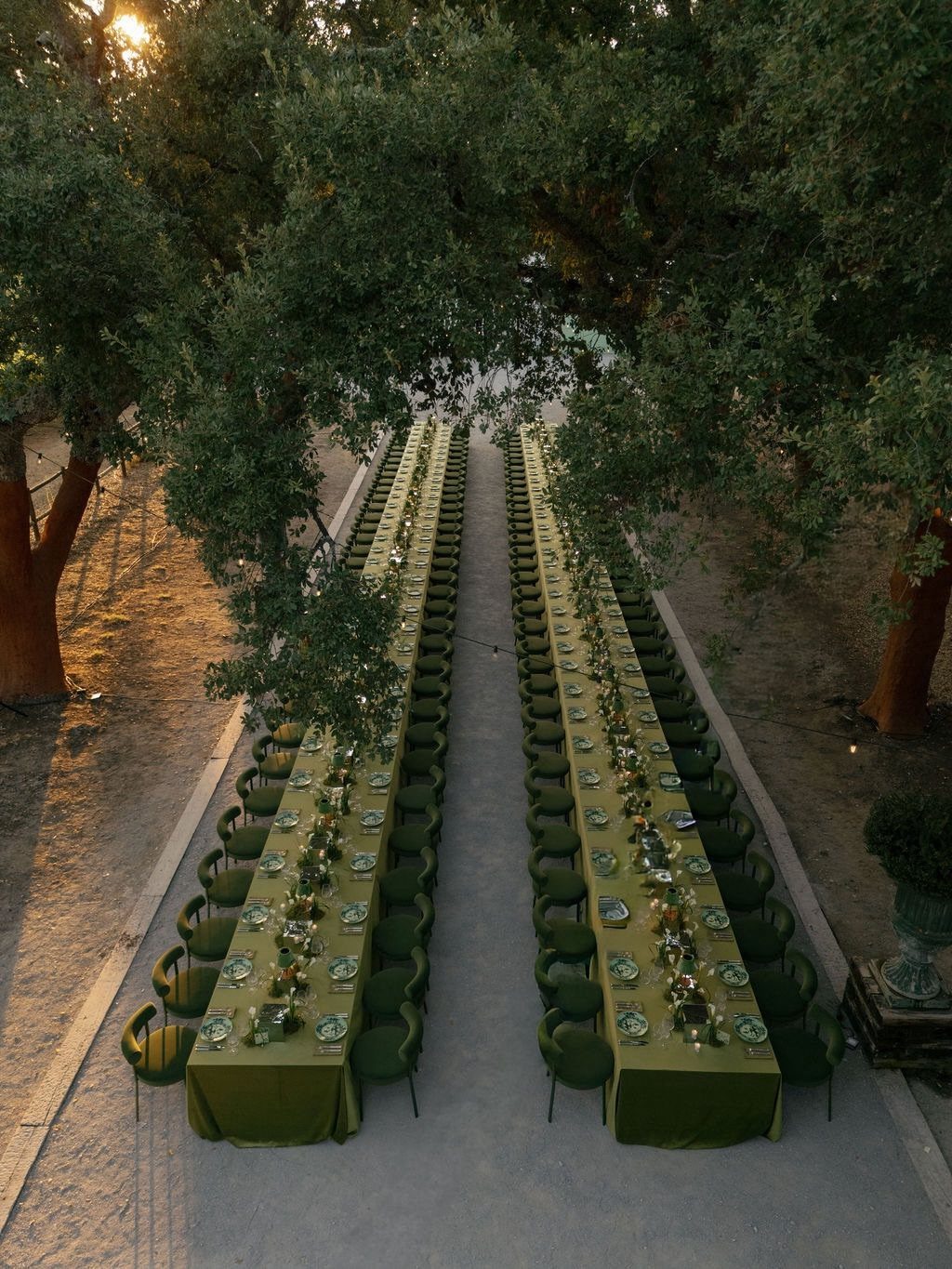
Two or more straight tables running side by side turn a reception into a dining hall where everyone eats together but no one walks a mile to the restroom.
The aisles between rows matter as much as the tables themselves; leave enough width for a server to pass with a tray without making a guest stand up.
This layout scales to any guest count by adding tables, not length, which suits budgets where rental cost scales by piece.
The trade is intimacy: conversation stops at your row, and the couple at table 3 might as well be at another wedding.
Outdoor settings with unlimited length solve the indoor problem of walls that cut short your ambition. Indoors, check ceiling height; parallel rows under low beams feel like a cafeteria.
Seat your loudest friends down the same row, your quiet ones across the gap, and everyone finds their level without a seating chart that reads like a logic puzzle.
An 8-foot trestle will seat 4-5 guests per side. As a common guideline, allow no less than 50cm per guest per side of the table.
— The Lane
Choosing the Right Table Shape
Start with what your venue actually has in stock. Not every rental company carries curved or serpentine pieces, especially outside major metro areas, and shipping specialty shapes in from another city eats budget fast.
If you are set on a winding line of seating but the local inventory is all rectangles and rounds, cluster several rounds in a staggered row.
The shape reads as meandering from a distance, and guests still mingle across the gaps.
Odd numbers of straight tables, 3 or 5, let you center the middle table under a chandelier or beam for a natural focal point.
That center table becomes the obvious head table, and a floral installation hung overhead anchors the whole room’s sightline.
Match the table width to your centerpiece ambitions before you sign the rental contract.
A narrow table leaves no room for shared platters and a runner both; a wide one swallows a modest arrangement and makes conversation across it a shout.
Decorating Long Tables
Symmetry reads as intention on a long surface, but the spacing is what guests live with.
Clusters set close together mean no one sits far from something pretty; space them too far apart and the middle seats stare at bare cloth.
I have seen tables where the candles sat so close together you could not set down a water glass, and tables where the centerpieces looked like islands in an ocean of linen.
Measure your table length, decide your cluster width, and divide.
Overhead installations work best when they hang above a center table in an odd-numbered row.
The weight drops at the room’s midpoint, and the floral or lighting draws eyes up so the table itself can stay lower and clearer for plates and elbows.
Midday sun on a vineyard lawn washes out even a strong flame; dusk under a tent, a weak LED looks plastic. Buy one, bring it to the venue at the right hour, and decide before you order two dozen.
Guest Interaction
Long tables change how people talk. At a round, 6 conversations cross and overlap; at a long row, you are limited to your left and right neighbors, and perhaps the person across if the table is narrow enough.
Seat friends who already know each other in runs of four to six, so no one is stranded between strangers for the salad course.
The couple who met in your grad program, the college roommates, the cousins who see each other at holidays: group them, then break the groups with a single new face who fits the chemistry.
Traffic flow matters more with long tables than with rounds. One continuous table in a room’s center forces guests to walk the full length to reach the restroom or bar.
Check where the high-traffic paths land: bathroom doors, entranceways, the path to the dance floor. A table edge too close to any of them becomes a bottleneck by the second course.
Budget Considerations
Long tables cost more to dress than rounds because there is simply more surface to cover. One long table seating 40 has more edge to skirt, more center to fill, than four rounds of 10 each.
A florist needs to know your table dimensions, linen choice, and place setting plan before quoting centerpieces; a runner on bare wood needs different treatment than full cloth to the floor.
Rentals stack up item by item.
Tables, linens, possibly chairs if the venue’s do not match your look. Ask whether the caterer provides linens or if that is a separate rental; the answer changes which florist or rental company you call first.
Some venues include basic rectangles in the room fee; others charge for every piece, and specialty farm tables run higher than standard banquet width.
Centerpiece cost scales with table length, not guest count. Budget for that multiplication before you fall in love with a per-cluster price that sounds manageable.
Frequently Asked Questions
What are long tables at weddings called?
People call them banquet tables, farm tables, vineyard tables, or king’s tables depending on the style and who’s sitting there. The names overlap a lot; a florist will want the actual dimensions, not the label, before quoting centerpieces.
Rental companies do not agree on names; the same 8-foot rectangle gets called a farm table by one and a banquet table by another, so ask for dimensions, not labels.
How many long tables for 100 guests?
A single continuous table suits up to about 100 guests before the length becomes unwieldy; beyond that, you are looking at parallel rows or a U-shape.