The 17 couple pictures wedding ideas I gathered run from a quiet church pew moment to a sparkler exit with a dip kiss, across every light condition and level of staging your day will actually allow.
What picks one over another is not how beautiful it looks online but whether your photographer can work invisibly in that specific space, because the shot that survives is the one where you forgot the camera.
[link-whisper-related-posts]1. First Look Portraits
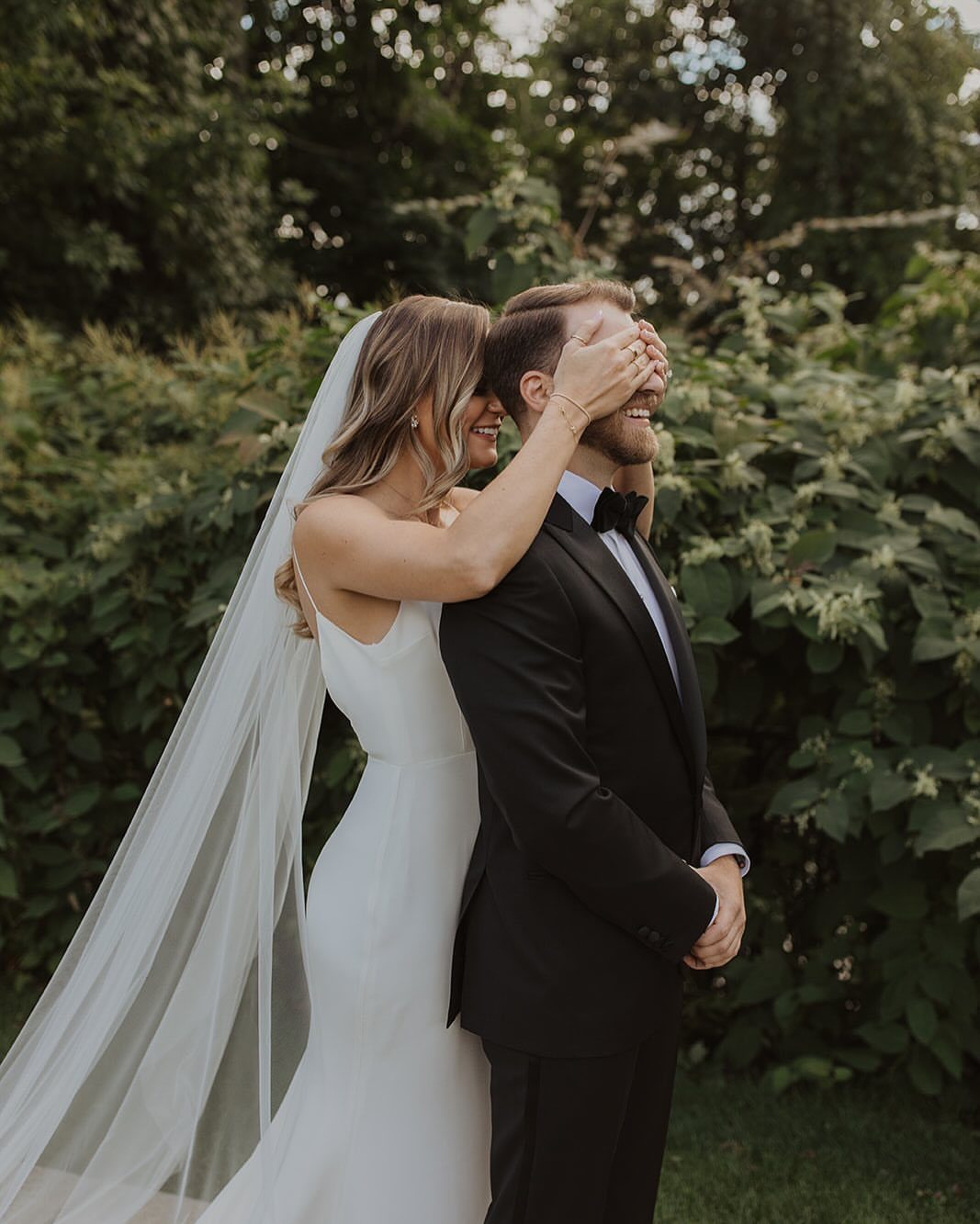
A first look is the one moment on your wedding day when the performance drops away and something real happens on camera.
I like these set somewhere with a wall or a hedge behind the groom so the photographer can shoot his face dead-on when he turns.
Pick a spot away from guests, even away from the wedding party if you can manage it. A garden corner works, or the far end of a hotel hallway, or a courtyard you can close off long enough to breathe.
The photographer needs to be in position before you arrive, hidden or at a distance, so the reaction reads as uninterrupted.
The bride approaches from behind, covers his eyes, waits for him to turn. Some couples add a tap on the shoulder; some let the hands drop slow.
Either way, the instruction to give your photographer beforehand is: stay still, shoot through it, do not interrupt for a posed re-do. The first take is the one you will want.
2. Walking Shots
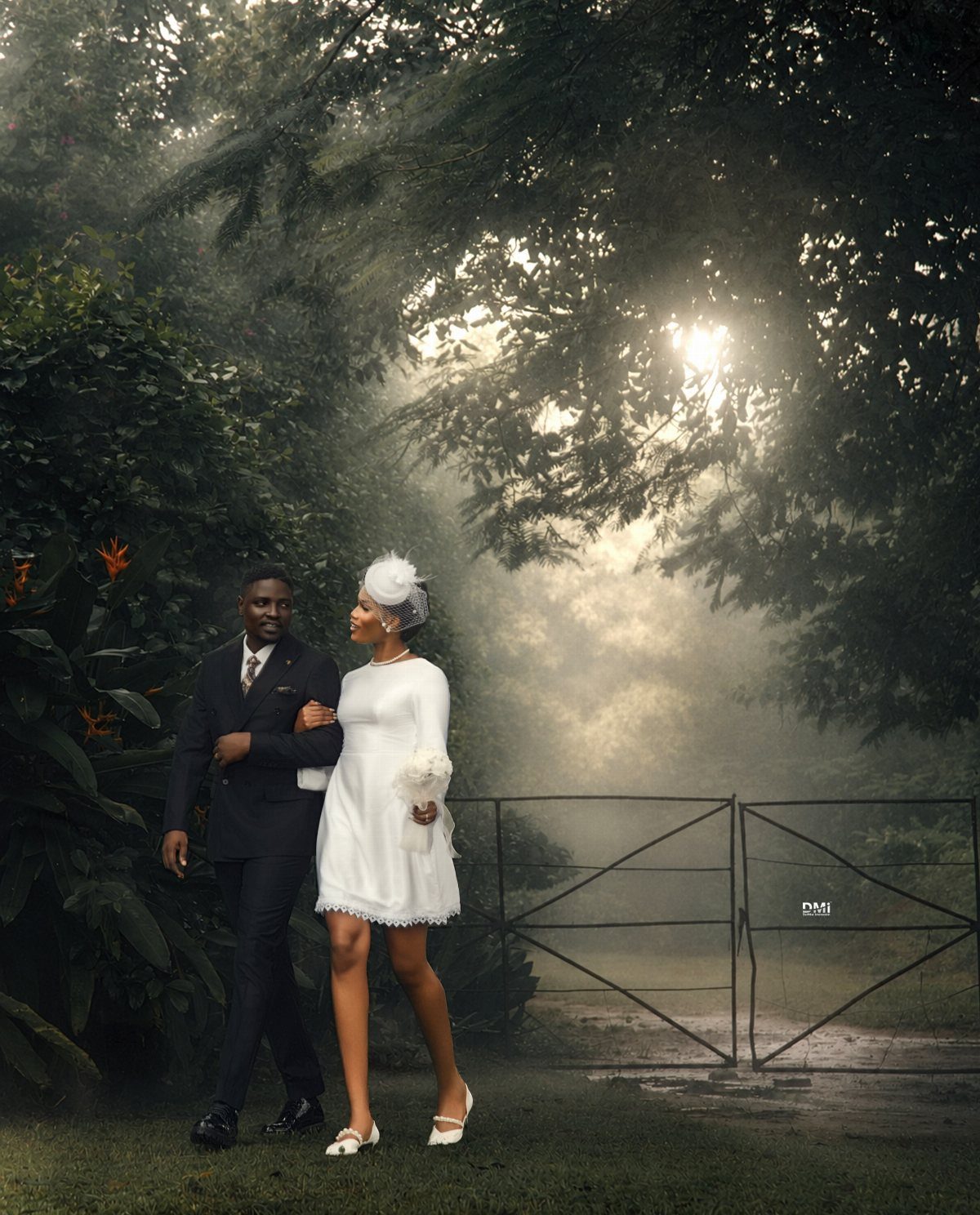
Walking shots succeed because the couple has something to do with their bodies besides perform affection for a lens. The movement loosens the shoulders, the conversation starts up again, and the photographer catches what happens in between the poses.
I have seen these work on cobblestone streets, through overgrown garden paths, across parking lots that happened to have good late light.
The setting matters less than the direction you give: walk toward a real destination, not in a circle for the camera.
Have the photographer walk backward ahead of you, or shoot from a balcony or a doorway you are about to pass through.
Mist and morning light help, but so does a plain overcast afternoon.
The one thing that kills a walking shot is the couple checking back at the camera every third step. Agree beforehand that neither of you looks at the photographer unless asked.
3. Entwined Fingers with Wedding Rings
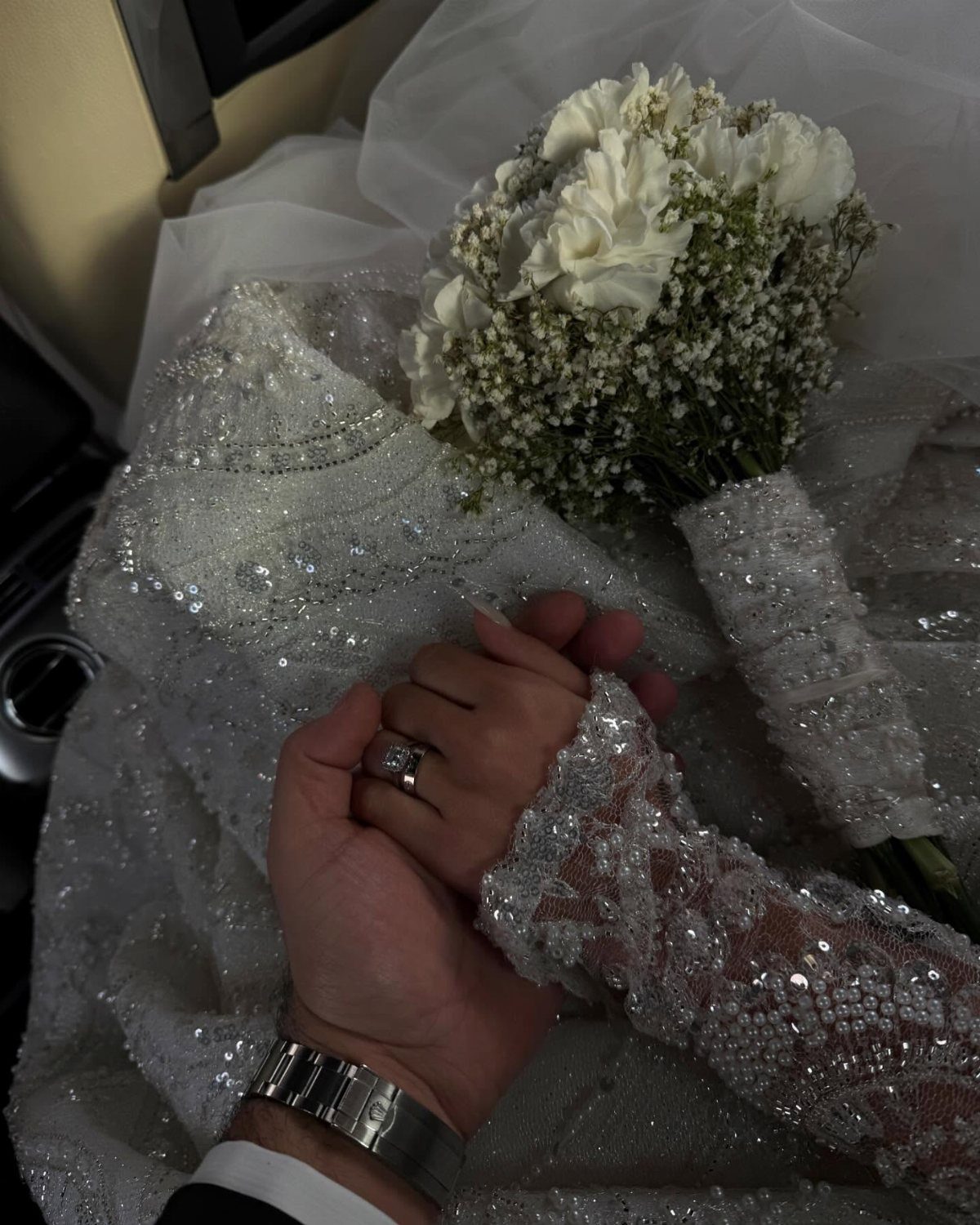
This is the shot for when you want intimacy without full-body vulnerability. Hands and rings photograph well inside a car, where the door frame gives the image a natural boundary and the light comes from one side only.
Crossed hands over the bride’s skirt, with the bouquet nearby for texture, gives the rings a natural frame.
You could do this on a bench, at a table, in the back seat. Turn the hands until the metal glints rather than shooting flat-on; the rings need light to catch.
A photographer working close with a macro lens will ask you to hold still longer than feels natural; the stillness is what keeps the fingers from blurring.
If your rings are plain bands, the shot still works. The gesture matters more than the stones.
4. A Staircase Moment
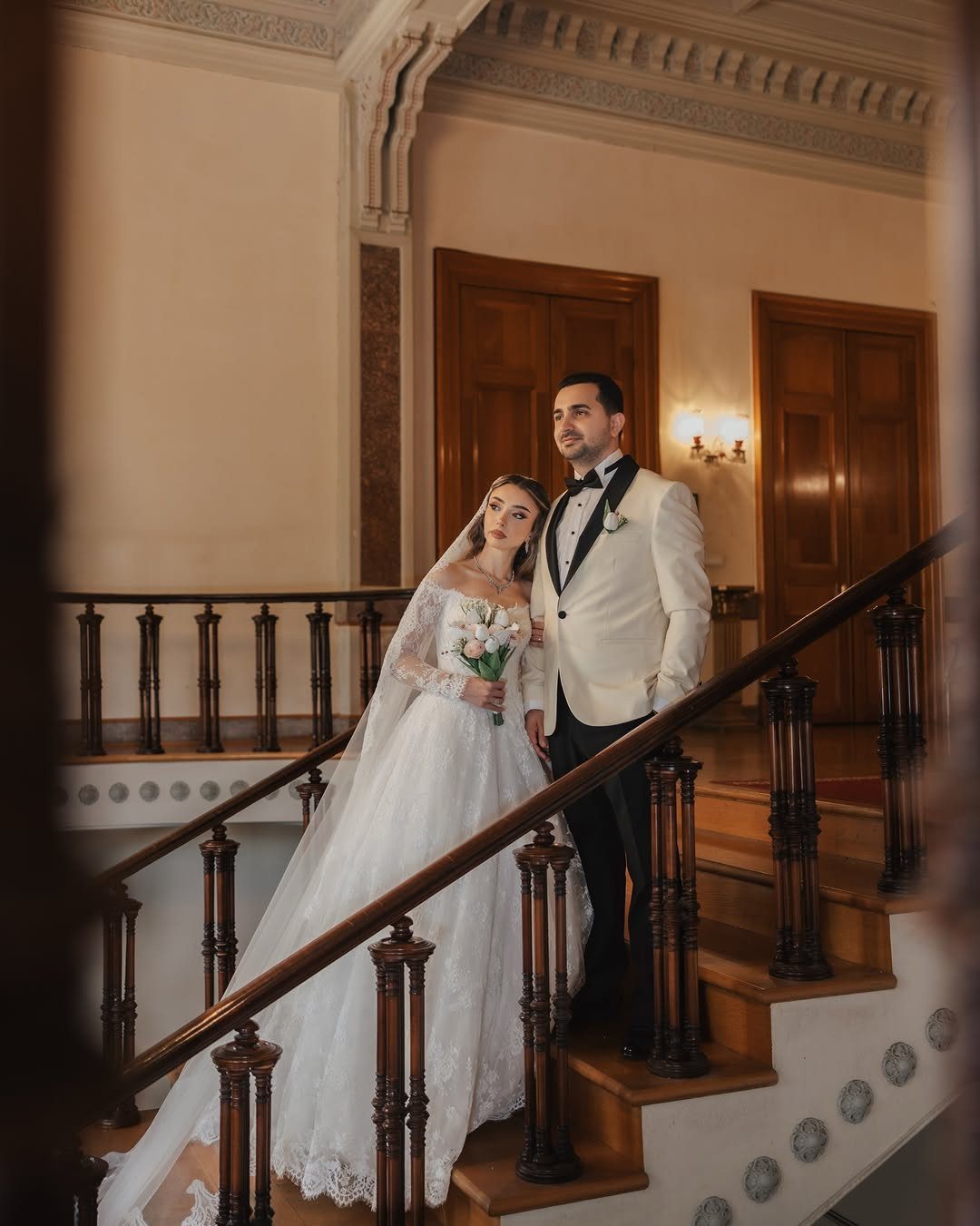
A staircase gives you built-in geometry without building a set. The steps create levels, the railing leads the eye, and the vertical space lets a long train or a full skirt read as dramatic rather than cumbersome.
Ask the photographer to shoot from the landing below, looking up, for the descent shot; from halfway up, level, for the posed pause; from directly above, if the stairs curve, for the editorial layered look.
One partner a few steps above the other breaks the symmetry in a way that photographs as tension rather than accident.
Stone steps read formal, wooden ones warm, metal industrial.
Ornate carved wood in a grand hall suits traditional dress. A modern venue with a floating stair would call for cleaner lines in the posing, less flourish in the gesture.
5. Under the Veil
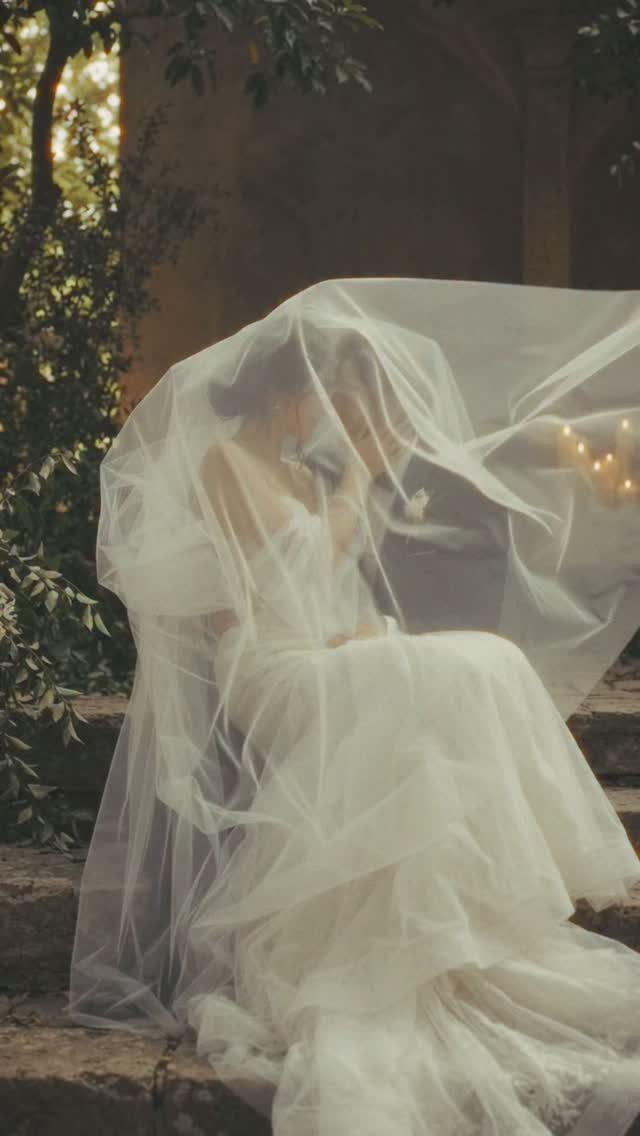
The veil shot is the closest thing wedding photography has to building a room out of fabric. The material diffuses hard light into something soft enough to shoot into, and it shrinks the world to just the couple inside.
The visible photo has the couple seated on stone steps, the veil spread overhead like a canopy.
To get this, you need a long veil, an assistant or a windless day, and a groom willing to sit still while the fabric is arranged over him.
The bride often holds the edges; in some setups, a bridesmaid stands just out of frame with fishing line. The photographer shoots from outside the veil or, for a hazier effect, ducks underneath with you.
The light should come from behind or above the veil, not from in front, or the faces go flat. Morning or late afternoon, when the sun is low enough to back-light, works better than overhead noon.
6. Close-Up Portraits
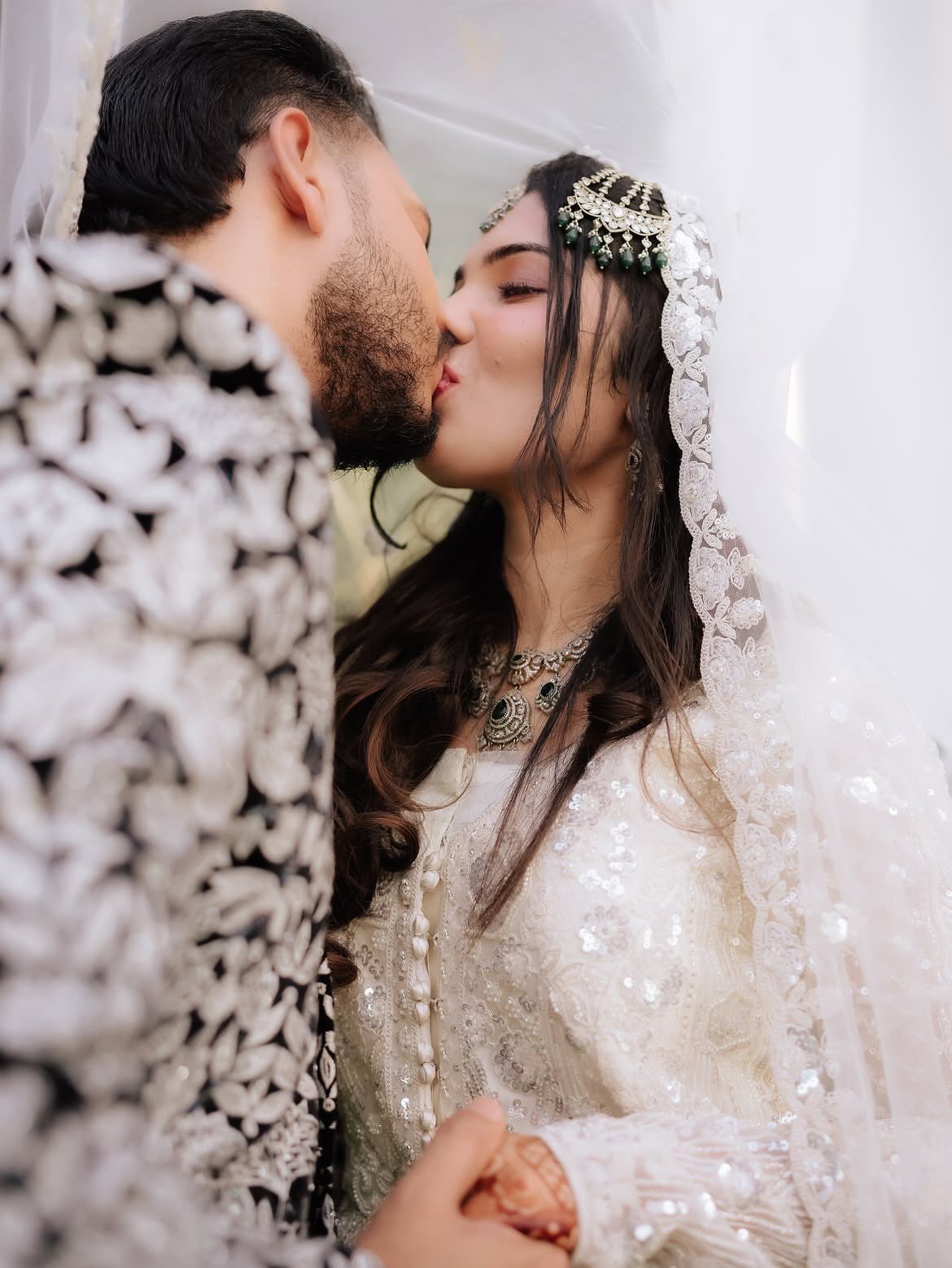
A close-up portrait strips out the venue, the dress, the flowers, everything that signals "wedding" at a distance, and leaves only the 2 faces and what passes between them.
These are the images that survive long after the trends they were shot in have dated.
The photographer needs to be close, within arm’s reach, with a lens that does not distort. The couple needs to forget the camera is there.
I have seen photographers achieve this by having the couple whisper secrets, real ones, not prompts; by counting to three and then holding silence; by asking one to describe the other’s worst habit.
The reaction, not the pose, is what fills the frame.
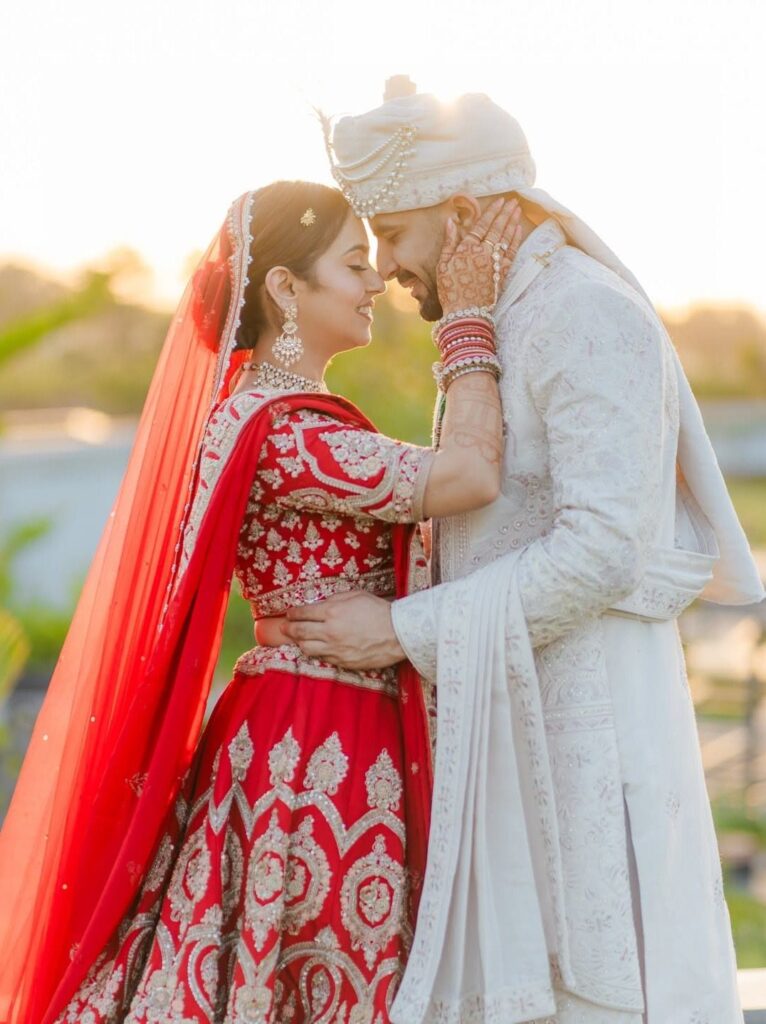
The visible photo catches a kiss in traditional dress, the embroidery and the veil framing the faces. A close-up during a quiet gaze works equally well, and sometimes reads as more private, less performed.
7. Car Shots
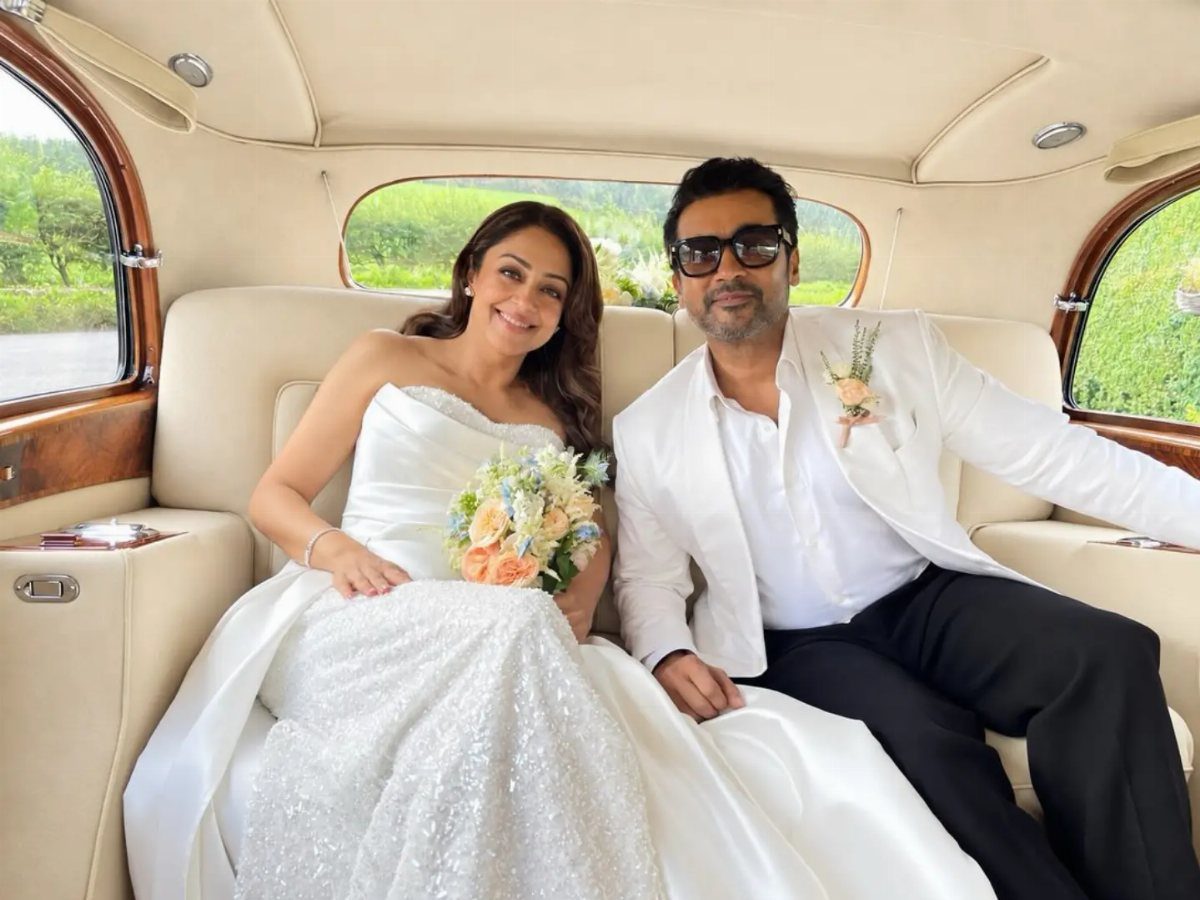
A vintage car gives the couple a destination and a frame at once, the leather seats and polished metal doing half the work of making the shot feel considered.
The photographer can shoot from the driver’s seat turned around, from outside the open door, or through the front windshield with the couple in back.
Leaning out the window works best when the car is stopped and the photographer is standing still; safety first, and the relaxed shoulders show it.
Kissing in the backseat needs the photographer close, sometimes crouched at the open door, sometimes shooting from the opposite window with the glass down.
The car should be clean inside, and the couple should sit on the same side, not opposite. Sunglasses or no sunglasses, decide beforehand so one of you is not caught mid-choice.
8. Couple with Pets
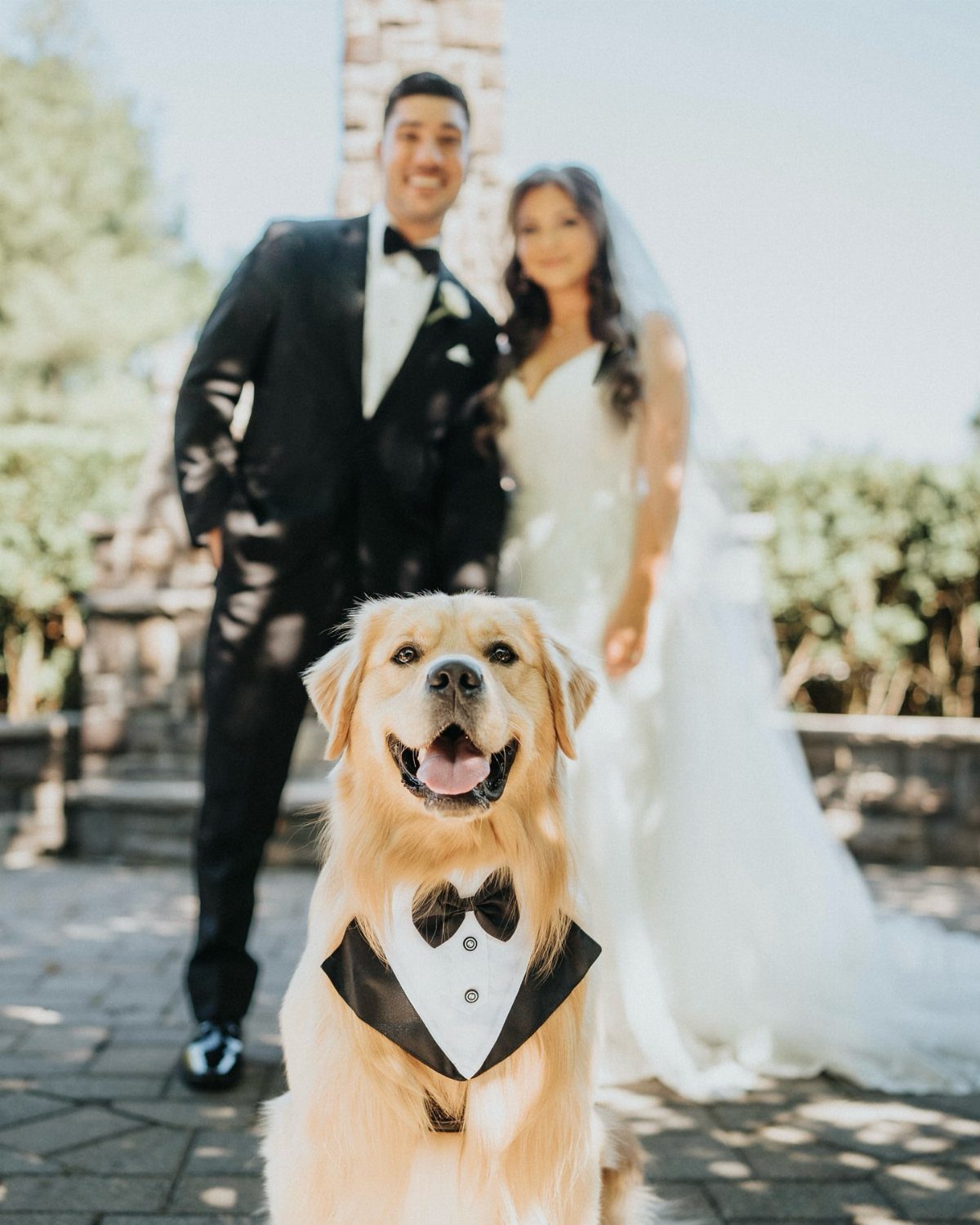
A dog in formalwear steals focus by design; the couple accepts this and plans for it.
The pet should be handled by someone not in the photos until the moment arrives. A trainer or a friend holds the leash off-camera, then steps back on cue.
The dog sits or stands in the foreground, the couple arranged behind at a distance that softens them into the background. The photographer kneels low to get the dog at eye level, which also makes the couple loom gently behind.
A bandana reads playful, a small bow tie formal; either way, dress the pet early so they stop fussing before the camera appears. Bring treats, and schedule this shot when the dog is fed and walked, not hungry and restless.
9. Couple Silhouette Against Sunset
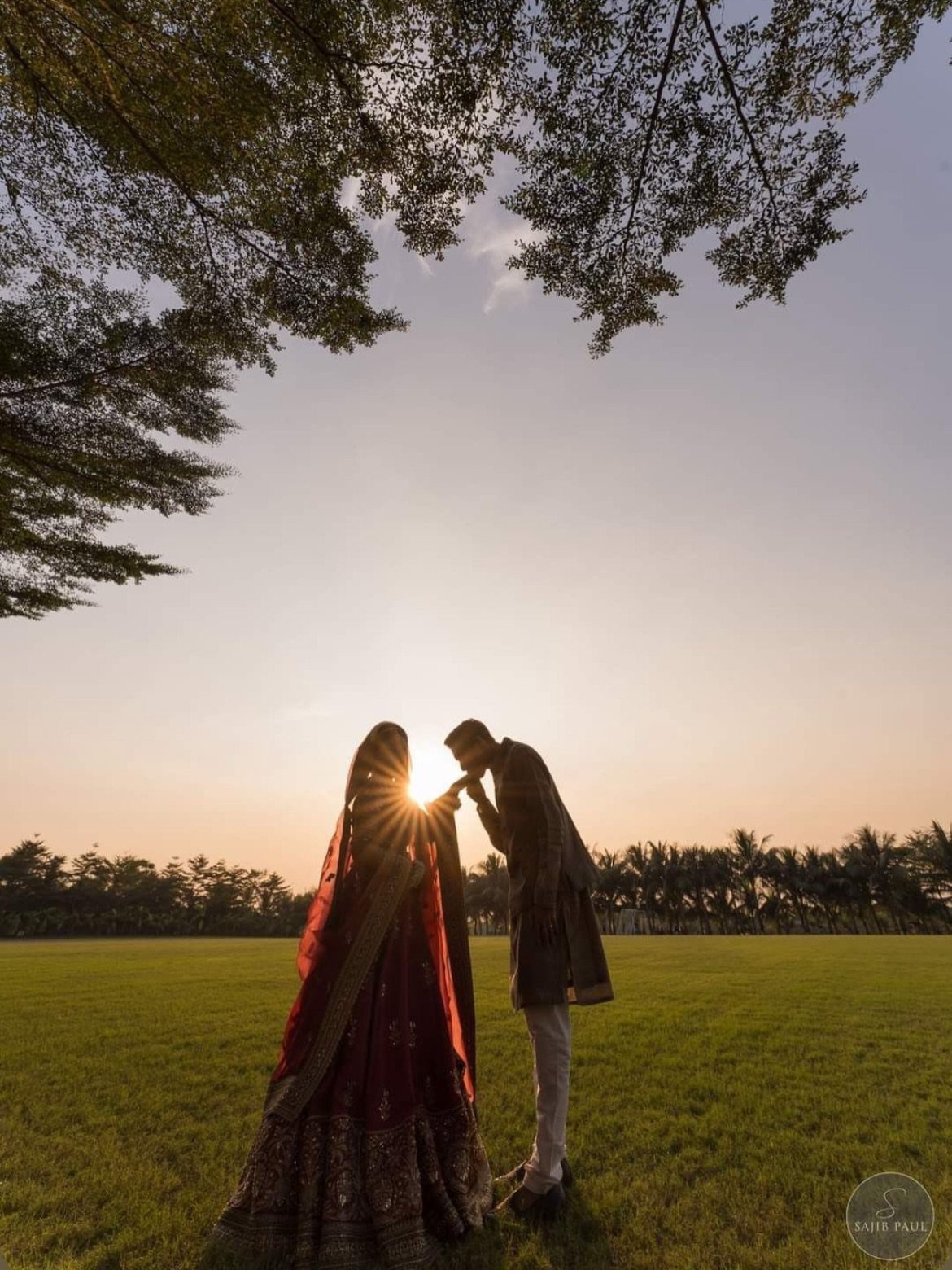
Silhouette shots trade facial expression for body line, so the pose matters more, not less.
The couple stands between the camera and the light source, close enough that their shapes overlap cleanly. Holding hands with arms extended creates negative space between the bodies; a kiss or an embrace merges them into one shape.
The photographer exposes for the bright background, letting the couple fall to black. A starburst effect, like the visible sun between 2 figures, needs a small aperture and a low sun, near the horizon.
Windless evenings work best; loose fabric or hair catches light and breaks the clean edge. A full skirt gives the silhouette its shape against the sky; color matters less than volume when the sun drops behind you.
10. Couple in Scenic Landscape Backdrops
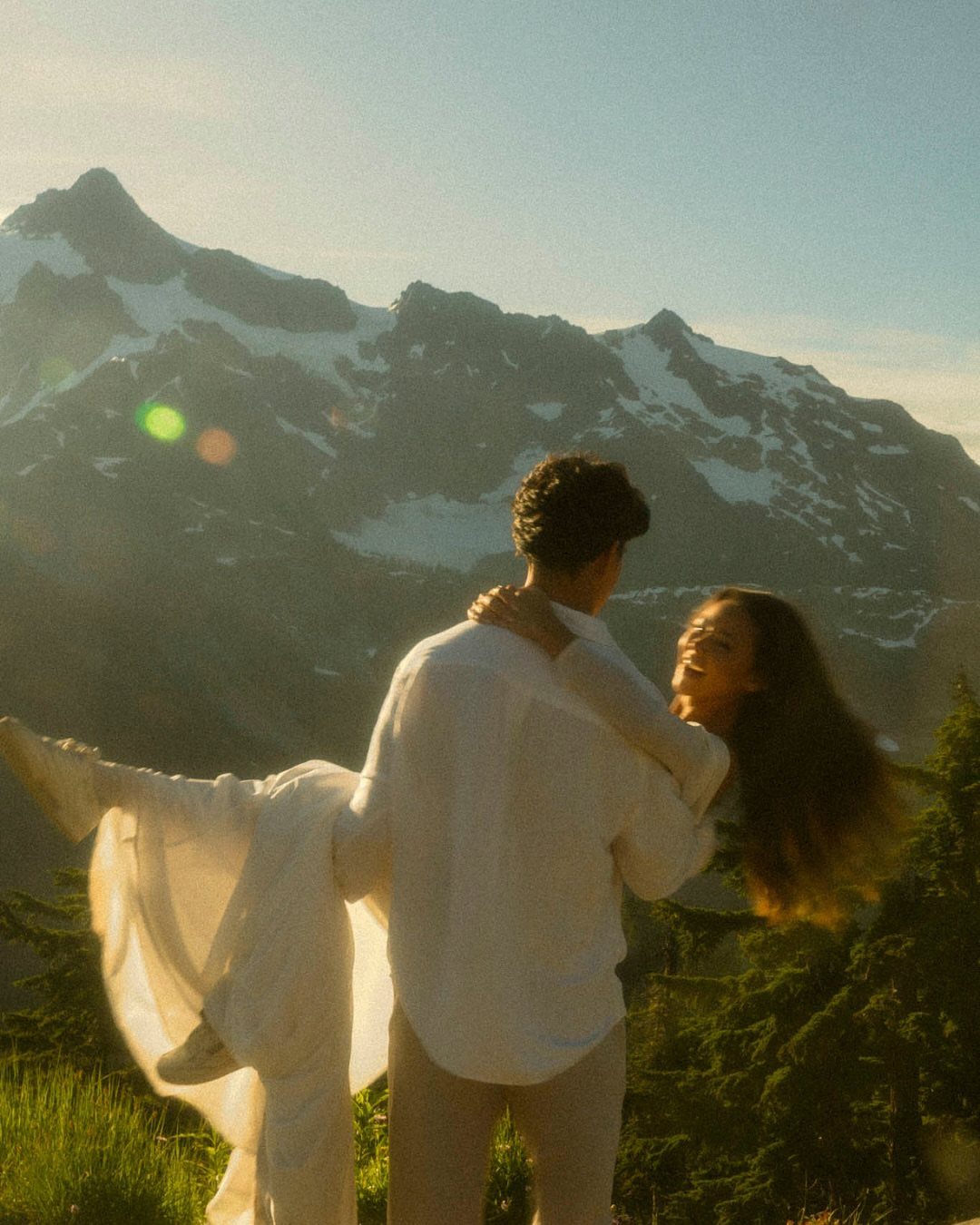
The photographer places the couple in the lower third, the mountains or meadow filling the rest.
A lift, a spin, or a walking stride gives the bodies action that reads at a distance; standing still tends to disappear. White or light clothing separates from dark trees or rock, while deeper colors hold against snow.
Travel to the location adds time and sometimes permits, so build it into the day’s schedule, not the margin.
Morning light on the visible peaks is cooler, afternoon warmer; both work, but the couple and the photographer should agree on the timing before the day arrives.
11. Couple in Traditional Poses
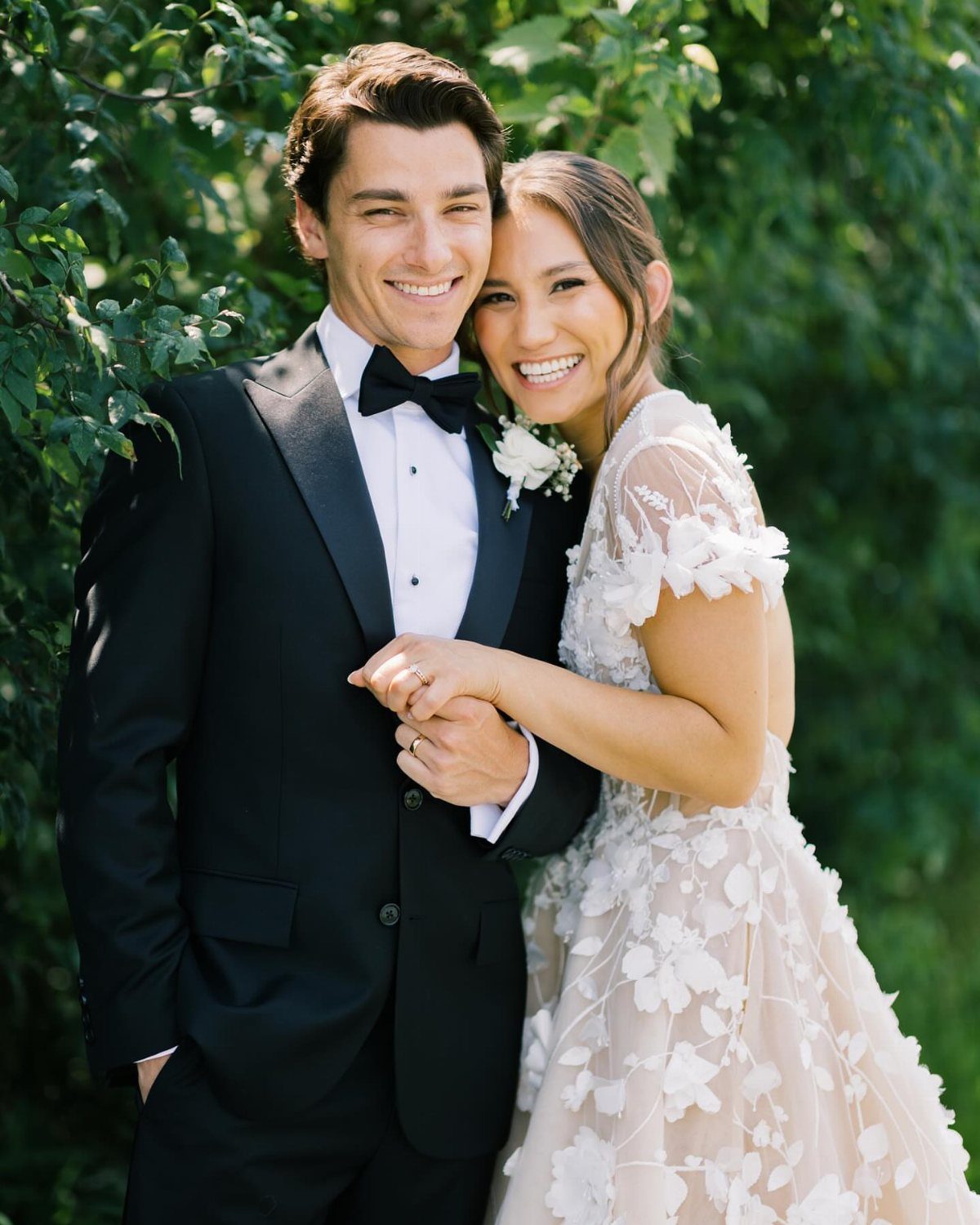
Traditional poses survive because they require nothing but the couple and a willingness to stand close.
The groom’s hand at the bride’s waist, the bride’s hand at the groom’s lapel, foreheads nearly touching: these arrangements have been tested across generations.
The photographer adjusts angle and distance, but the pose itself needs no instruction beyond the first placement. Soft smiles read better than full grins in this style; the eyes do the work.
Green foliage behind gives natural contrast without pulling focus from the couple.
A busy background fights the simplicity that makes these portraits last. Ask for one set like this even if the rest of the day runs modern; your future self will thank you.
12. Elevator Moments
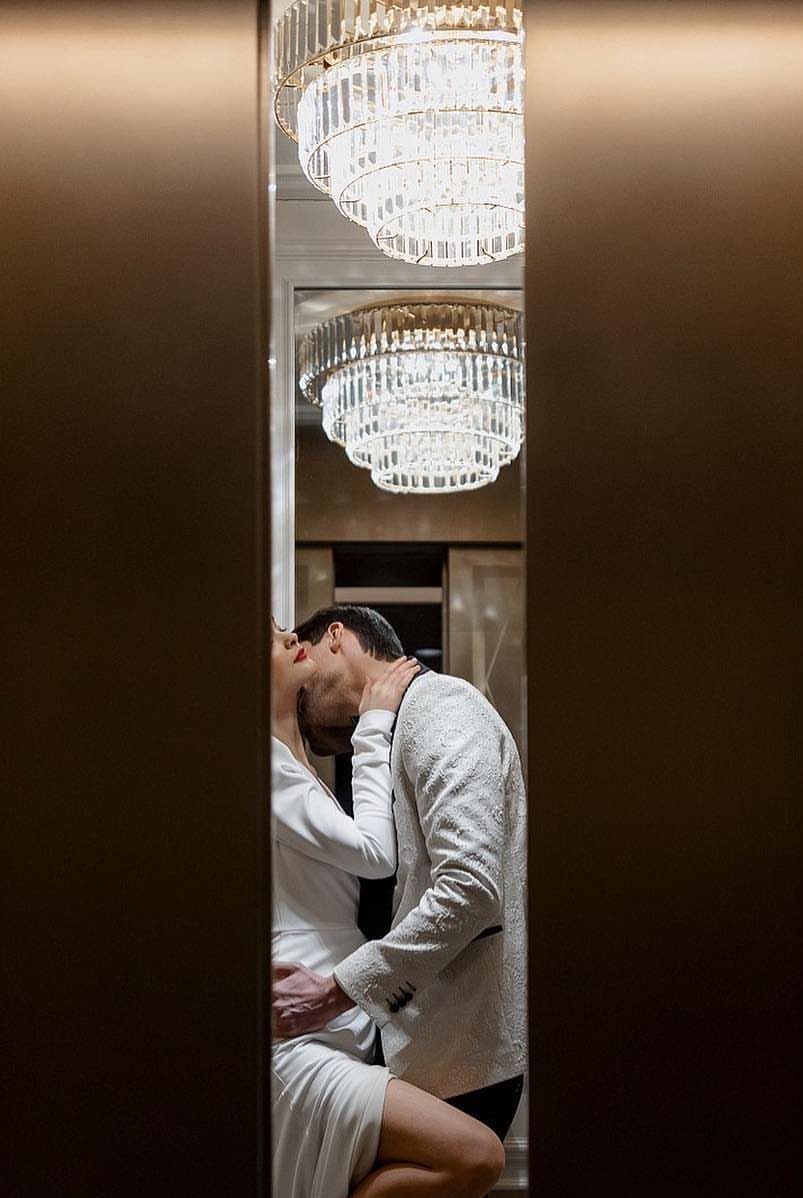
An elevator is a small stage with a door that closes, and that closing is the shot.
The photographer stands outside, lens through the narrowing gap, catching the couple as the doors meet.
Crystal chandeliers above, bronze or mirrored walls around: the confined space throws light back from every surface, so exposure stays easy even in a hotel corridor.
The couple embraces, kisses, or simply looks at each other; the door frame does the compositional work.
Timing is the hard part. The photographer needs the elevator held or a second empty car to practice the angle.
Candid laughter works better than a held pose; the doors move, the moment is brief, and the couple should be mid-gesture when the gap narrows to its final width.
13. The First Dance
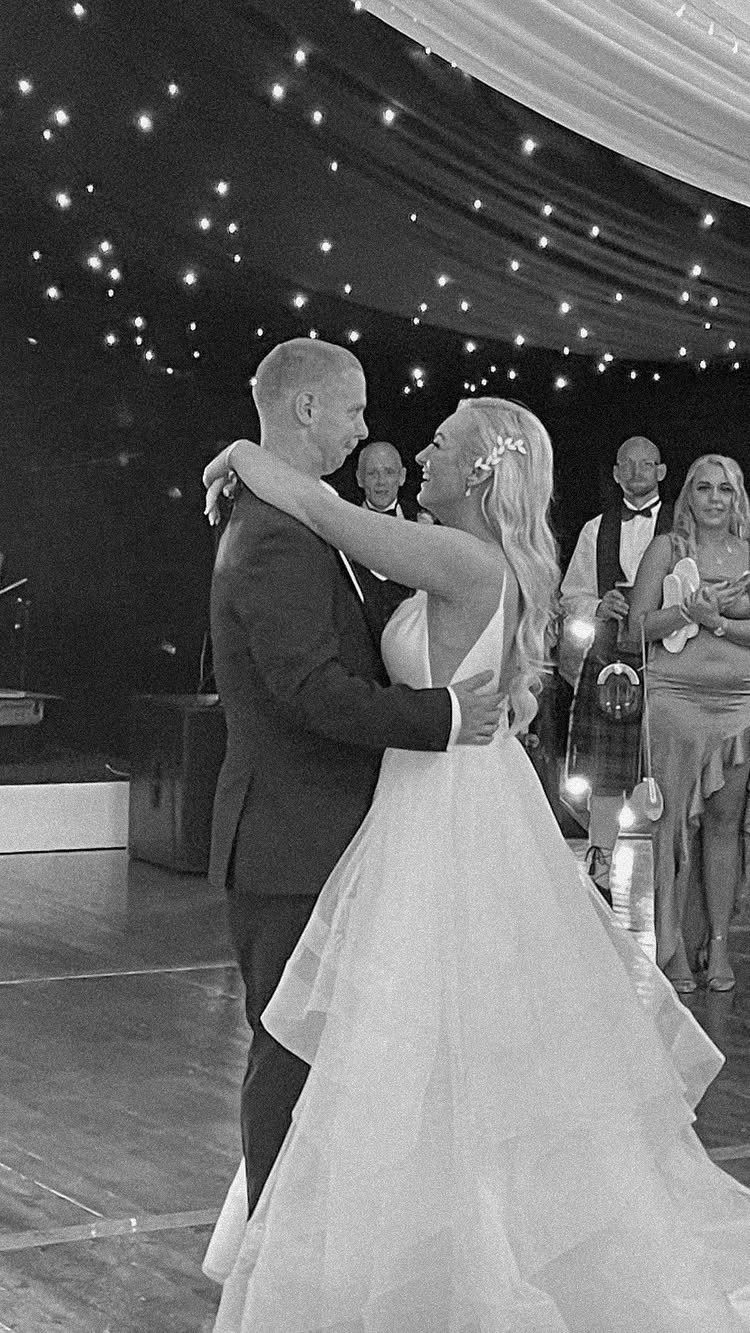
The first dance is the moment the couple stops performing for the camera and starts performing for each other. The guests become background, the band becomes background, and what remains is two people who have just promised something permanent.
String lights overhead give the photographer warm points to blur behind you; a spotlight from the venue creates a harder, more theatrical edge.
The photographer should be close enough to catch hands and faces, not across the room with a long lens that turns you small against the floor. A second shooter from the side catches the guests’ faces as they watch.
Ask your DJ or band to hold announcements until the song is truly done; the photographer needs the ending, not the applause that follows.
14. Sparkler Dip Kiss
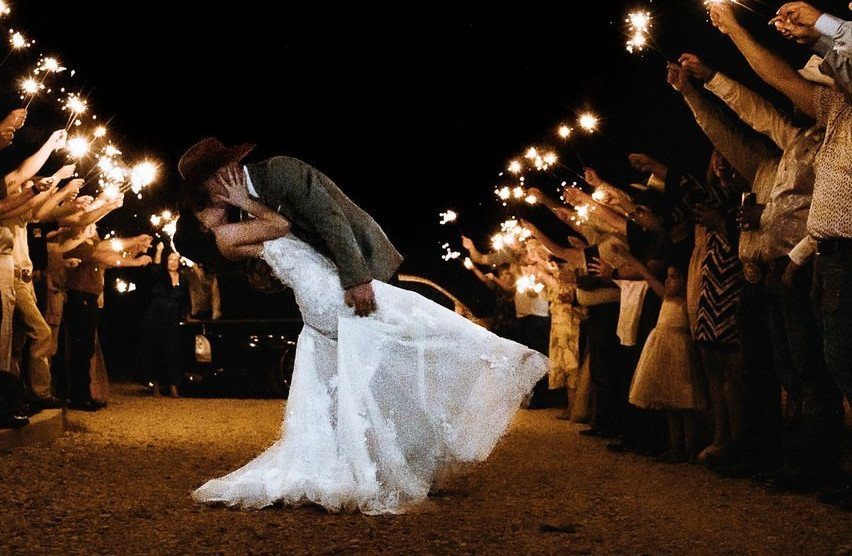
A sparkler exit with a dip kiss turns the departure into a single frame that reads as celebration and romance at once.
The guests line both sides, arms raised, the couple passes through, and at the far end the groom dips the bride into a kiss while the sparks still burn.
The venue or a designated friend should hand out sparklers lit from a central flame, not from lighter to lighter in a chain that leaves half of them unlit.
The photographer needs a fast lens and a steady position at the end of the line, not walking backward through the crowd. Windless air keeps the sparks vertical and the clothing safe.
Check whether your venue permits sparklers on the grounds; many do not, and the deposit is not worth the gamble.
15. Church Pew Intimate Moment
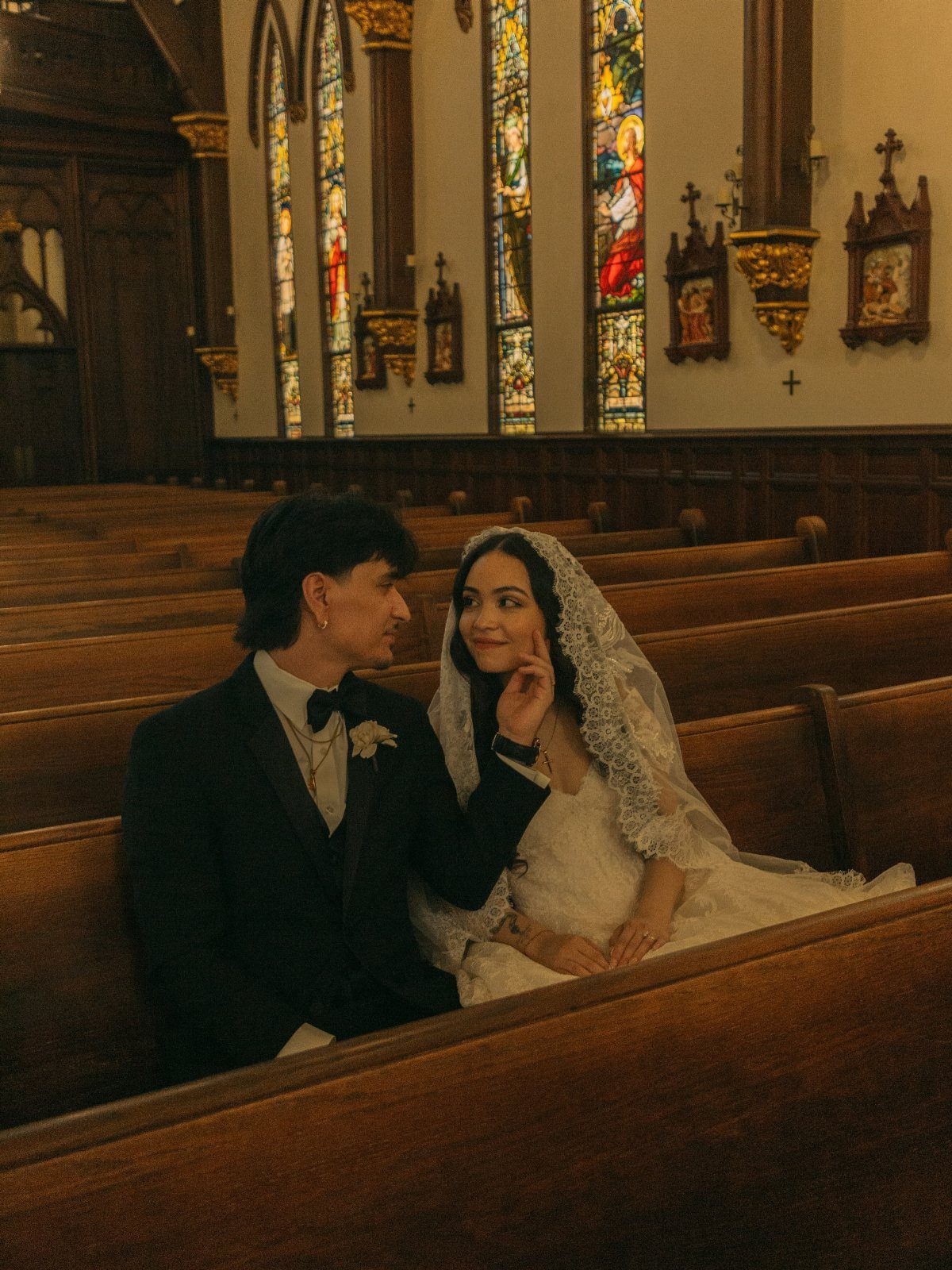
A church pew shot trades the open sky for colored light through glass, the wooden bench for a meadow, and the result is intimacy built from stillness rather than movement.
The couple sits close, turned toward each other, the rest of the pew empty around them.
The photographer stands in the aisle or at an angle from the nave, catching the stained glass as blocks of color behind the figures rather than letting it dominate.
Morning light through east windows gives warm tones; afternoon through west windows does the same, just later in the day.
The couple should not look at the camera; the shot depends on the sense that they have been found in a private moment.
Check with the officiant about photography during the ceremony itself, and schedule this for before or after if needed.
16. Playful Lawn Games
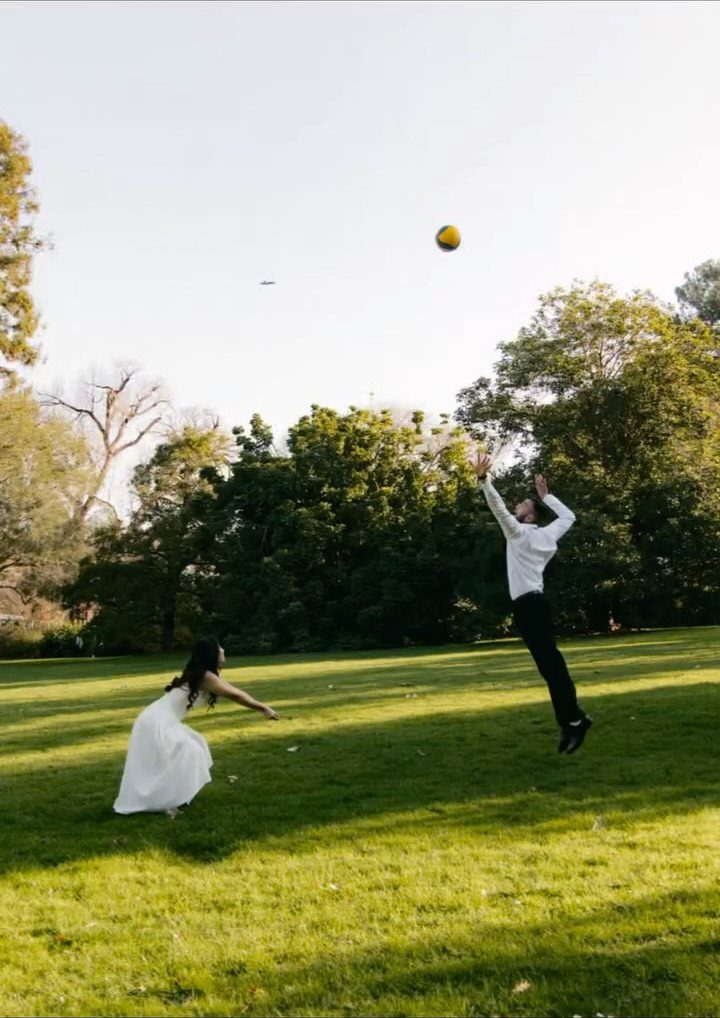
Lawn games give a couple something to do with their bodies that is not posed affection, and the photographer catches the reach, the laugh, the competitive glance that follows a bad toss.
A volleyball and a sunny lawn work well for this, with the groom airborne and the bride ready beneath.
Any game works: croquet, badminton, a frisbee pulled from the reception kit. The clothing stays formal, which is the point; the contrast between white gown and casual play is what makes the image.
The photographer needs to be low, at knee height or below, to give the leap its height and the lawn its expanse.
Schedule this for cocktail hour, when the light is still good and the couple has not yet relaxed into full informality.
17. Rustic Indoor Silhouette
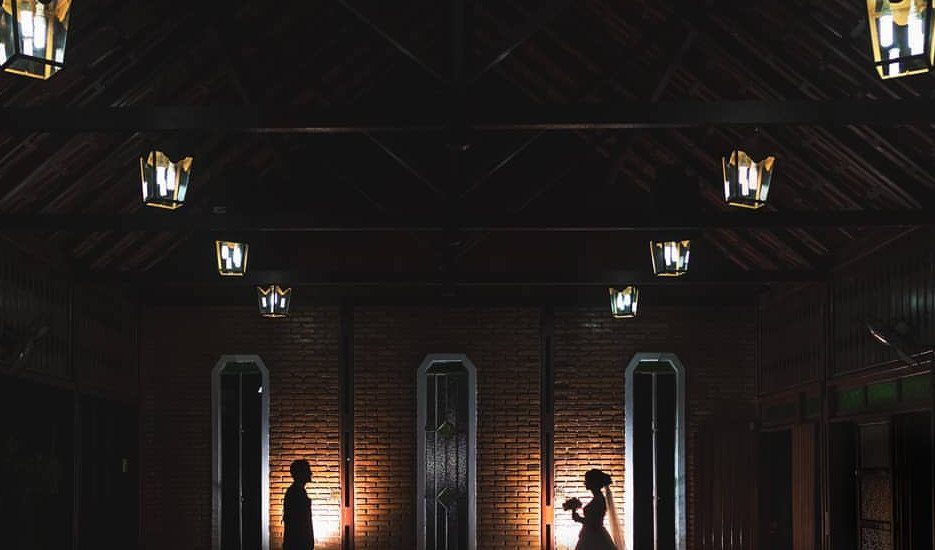
A silhouette indoors needs darkness in front and a single strong source behind, and a rustic brick room with hanging lanterns provides both without extra equipment.
The bride’s veil and full skirt give the silhouette its detail; without them, two figures merge into one dark blob.
The photographer exposes for the lanterns, letting the couple fall to black, and checks that no stray light from a window or door catches the front of a face and breaks the effect.
This trades facial expression for shape and gesture, so the pose must carry more meaning. A hand at the waist, a turned head, a slight lean: these read as tenderness when the face cannot.
Importance of Capturing Moments
The photos that last are rarely the ones you planned.
This matters long after the day ends. The research on relationship maintenance is clear: couples who revisit shared experiences through photographs report stronger connection during stressful periods.
The images become a stored language, a way to remember not only how the day looked but how the bond felt when it was fresh.
I think of it as building an inheritance. The wedding is one chapter; the photographs are how you hand it forward.
Photographer’s Role
A photographer who cannot put you at ease will cost you more than money.
The notes I gathered from couples who regretted their choice all named the same failure: silence when direction was needed, or intrusion when intimacy was happening. The wrong photographer leaves you feeling watched rather than witnessed.
The right one works almost invisibly. They arrive early to learn the light, they move without drawing eyes, and they save their voice for moments when a small adjustment turns a stiff pose into something livable.
They do not need you to perform; they need you to forget them.
Ask to see a full gallery from a similar wedding, not the highlight reel. Five good shots out of five hundred is a gamble; fifty good shots out of five hundred is craft.
Planning for the Shoot
Location scouting belongs to the photographer, but the decision belongs to you. A spot the photographer chose without asking about accessibility, about shade at 2 PM, about whether a permit was required, can derail the whole session.
The result is stress that shows in the shoulders, in the watch-checking, in the smile that does not reach the eyes.
Walk the location together before the day, if distance allows. Note where the sun falls, where crowds gather, where a quiet corner exists for the moments that need breathing room.
If travel between sites is required, build in time for wrong turns, for traffic, for the dress that needs arranging after a car ride.
The schedule should pad, not compress. A couple rushing to the next location performs anxiety, not connection.
Candid Vs. Posed Photos
Posed photographs serve a purpose.
They satisfy family expectations, they document the dress and the venue, they give you something predictable to frame. But the images couples return to, the ones they send to friends unprompted, are almost always the candid frames.
The difference is not technical; it is emotional.
A posed shot records that you were there. A candid shot records that you were together, in the same feeling at the same moment, unaware of being seen.
I balance this by asking for a short list of must-have poses, then releasing the rest of the time to chance.
The photographer knows the list and works through it efficiently; the remaining hours belong to observation, to waiting, to catching what happens when the instruction stops.
Frequently Asked Questions
What are some good ideas for wedding photos?
The strongest couple-only shots give you something real to do instead of performing for the camera. A first look, with the bride approaching from behind and the groom turning unscripted, catches a reaction that cannot be staged twice.
A real destination gives the body something to do, and the photographer gets what happens in between. For intimacy without full-body exposure, entwined hands with rings turned to catch the light work inside a car or at a table.
These are the shots that hold the gallery together, because they show how the bond felt, not just how the day looked.
What are some good poses for couples?
Walking shots succeed when you move toward a real place, not in a circle for the lens, with the photographer ahead or above.
Close-up portraits strip out the venue and flowers until only the 2 faces remain, often built by whispering actual secrets or holding silence after a count.
Entwined fingers over the bride’s skirt, with rings turned to glint, give intimacy without vulnerability.
The first dance pose is not a pose at all: the couple performs for each other while the guests blur to background, the photographer close enough for hands and faces.